


Price Breakdown & Availability
Here's how current offers compare across retailers.
You Might Also Like
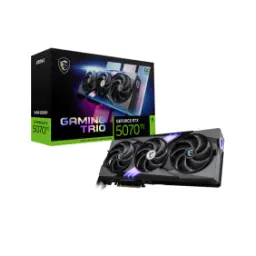
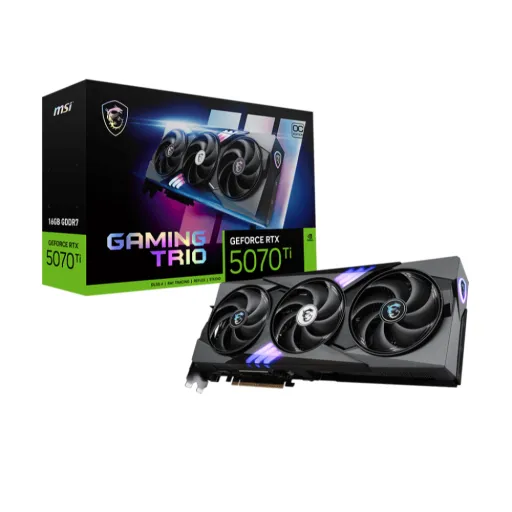
This MSI GeForce RTX 5070 Ti Gaming Trio OC Plus targets builders who want premium smoothness without turning the whole PC into a science project. The foundation is NVIDIA’s GeForce RTX 5070 Ti in the RTX 50 Series family, so ray tracing and AI features feel more native in daily play, bilkul gimmick wali feeling nahi aati. The GPU brings 8,960 CUDA cores, which helps push higher frame targets in modern engines and keeps heavy scenes stable, especially jab effects layer hotay hain. The OC Plus tuning lists a 2572 MHz boost clock with an MSI Center “Extreme Performance” target up to 2580 MHz, giving extra headroom for competitive titles without constant manual tweaking. The DLSS 4 stack adds Multi Frame Generation for GeForce RTX 50 Series cards, generating additional frames to lift performance when visuals are maxed, asaani se. The same DLSS suite is built to keep images crisp instead of muddy, so motion stays readable on fast pans and fine texture doesn’t blur out. The combined approach is meant to deliver fidelity and speed together, lekin control bhi rehna chahiye so long sessions don’t feel chaotic. The card connects through PCI Express Gen 5, letting it slot into modern platforms cleanly and leaving bandwidth headroom for future workloads. The 16GB GDDR7 frame buffer pairs with a 256 bit interface, so texture packs, creator timelines, and large worlds feel less constrained, memory pressure kam hota hai. The platform also leans into Blackwell era AI and RT improvements, which is why next gen rendering features show up as real workflow wins, not just checkboxes. The end result is a GPU that feels premium in use, rozana ke routine mein bhi
This card is ready for modern monitors and TVs, offering three DisplayPort 2.1b outputs plus one HDMI 2.1b port for flexible setups. The four output layout supports up to four displays and a maximum digital resolution of 7680×4320, so an ultrawide + side monitor combo stays easy to manage, bilkul. The HDMI path follows HDMI 2.1b positioning around high refresh 4K and 8K pipelines, which matters when living room gaming is part of the plan. The MSI listing also notes HDMI 2.1b support up to 4K 480Hz or 8K 120Hz with DSC, giving headroom for next gen panels even if today’s TV is more modest. The DisplayPort 2.1b side is especially useful for high bandwidth PC displays, and VESA has described DP 2.1b updates tied to longer DP80LL active cables for UHBR20 links. The practical benefit is cleaner long run cabling in desk setups, jahan PC thora door rakhna hota hai, while still aiming for high throughput connections. The MSI spec confirms multi display support for four screens, which makes streaming layouts and productivity grids feel natural, scene arrange karna asaan hota hai. The combination keeps high refresh motion clear, so fast camera turns look less smeary and small UI text stays readable. The ports also keep upgrades simple because you can mix DP gaming monitors with an HDMI TV, aur adapters ki tension kam hoti hai. The output standards are the kind that age well, because the bottleneck becomes the display itself rather than the connector. The net effect is a setup that feels ready for the next monitor cycle without forcing a complicated adapter chain
This RTX 5070 Ti platform is built for steady frame delivery, so fast paced games feel responsive even when effects stack up. The MSI OC Plus profile lists a 2572 MHz boost clock, and the MSI Center mode can reach 2580 MHz, which helps maintain snappy input feel, lag nahi hota. The 8,960 CUDA cores provide the raw shader throughput foundation, letting large scale effects resolve faster and keeping heavy scenes smoother, aur sudden dips kam hotay hain. The RTX 50 Series lineup is described by NVIDIA as using fifth generation Tensor Cores and fourth generation RT Cores, improving how AI and ray tracing share the workload. The DLSS 4 release introduces Multi Frame Generation for GeForce RTX 50 Series, which can generate up to three additional frames per traditionally rendered frame in supported titles. The meaningful takeaway is that high refresh targets become more reachable, especially jab ray traced lighting on ho, while visuals can stay clean. The card supports DirectX 12 Ultimate and OpenGL 4.6 in MSI’s listing, which helps keep modern rendering paths and broad compatibility available. The Gaming and Silent modes are both referenced alongside boost behavior, so you can prioritize acoustics without abandoning the tuned profile, asaani se. The advantage shows up in mixed workloads too, because the same horsepower that drives games also supports GPU heavy creative moments, rozana ke projects mein. The overall experience is about steady performance rather than peak spikes, jo daily use mein sab se zyada matter karta hai. The result feels refined on a high refresh display, where smooth motion is the first thing you notice
This MSI model ships with 16GB of GDDR7 memory, giving you a larger working set for textures, caches, and creative timelines. The memory is listed at 28 Gbps and uses a 256 bit interface, so bandwidth stays strong when high resolution assets stream in, asaani se. The benefit often shows up as smoother frame times in open world titles, because fewer sudden asset swaps mean less stutter, bilkul. The underlying GDDR7 standard (JESD239) is described by JEDEC as raising bandwidth and using PAM3 signaling to improve high frequency operation and energy efficiency. The same JEDEC announcement describes GDDR7 as offering double the bandwidth over GDDR6 in the standard framing, which matters as games and AI workloads keep expanding. The 16GB capacity also keeps multi app workflows calmer, so a game, a stream, and a browser can coexist with less VRAM panic, multitasking asaan hoti hai. The 256 bit bus is a balanced choice for throughput, while still keeping the board design reasonable for thermals and acoustics. The practical win is fewer settings compromises, kyun ke high res texture packs and big maps stop feeling like a tight squeeze. The setup also supports creators who keep multiple assets open, because VRAM headroom reduces the need for constant cache purges. The net feel is that quality presets become easier to hold at higher resolutions, where memory pressure is often the first complaint. The overall memory configuration is built for longevity, not just today’s benchmarks
This Gaming Trio OC Plus edition is tuned for sustained clocks, and MSI highlights STORMFORCE fans as the airflow foundation for lower noise during long sessions. The same design approach uses heat pipes to move heat away from the GPU quickly, heat kam rehta hai, so boost behavior stays more predictable. The metal backplate includes vents and thermal pads to improve overall cooling efficiency, which matters when the case airflow is average. The card’s physical size is listed as 338 x 140 x 50 mm, so planning your case clearance stays straightforward before purchase. The MSI spec also lists weight details for the card and package, which helps set expectations for handling and support, haath mein heavy feel surprise nahi deta. The cooling goal is stability, because a consistent thermal profile keeps clocks smoother from scene to scene and reduces sudden fan surges. The quiet benefit is real when you play late, kyun ke noise fatigue kam hoti hai and you can focus on audio cues. The sturdy backplate also helps the card feel more rigid in the slot, especially during installation and cable routing. The Gaming and Silent modes are both referenced for boost behavior, so you can choose a calmer acoustic profile without leaving the tuned experience. The practical takeaway is less thermal drama under load, performance bohat stable, and fewer reasons to micromanage fan curves. The end result is a cooler running card that tends to stay cleaner and quieter over time
This MSI RTX 5070 Ti model is listed at 300W power consumption, which helps you estimate heat and PSU headroom for the whole build. The power input uses a single 16 pin connector, and MSI notes an ATX 3.1 PSU recommendation for cleaner compatibility, asaani se. The minimum suggested power supply is listed as 750W, so upgrades often remain a simple PSU choice rather than a full rebuild. The interface is PCI Express Gen 5, and the RTX 5070 Ti is commonly specified as PCIe 5.0 x16, keeping the platform modern for years. The PCI SIG has described PCIe 5.0 as delivering 32 GT/s and up to 128 GB/s via x16 configuration, while maintaining backward compatibility with earlier PCIe generations. The real world point is that slot bandwidth is unlikely to be your limit, so the focus stays on GPU horsepower and cooling, bilkul. The 16 pin + 300W envelope also pairs well with tidy cable routing, which keeps airflow clean and dust pockets fewer. The build feels easier when you plan connector clearance, kyun ke tight side panels sometimes push cables into awkward bends. The MSI listing marks the card as VR Ready, so headset gaming stays on the table if that’s part of your ecosystem. The overall power profile is strong but manageable for performance focused mid tower builds. The net experience is less guessing and more predictable planning, which is what most builders want
This GPU is positioned as a gamer and creator tool, and NVIDIA frames the RTX 50 Series as serving gamers, creators, and developers with AI driven rendering advances. The Blackwell generation focus on neural rendering features means creative and gaming pipelines can share the same strengths, rozana ke edits mein bhi. The DLSS 4 suite is described as neural rendering powered by RTX Tensor Cores, which is why supported games can gain major FPS while keeping image quality sharp. The same NVIDIA messaging describes DLSS 4 being available across over 75 games and apps at rollout, so adoption isn’t limited to a single showcase title, bilkul. The MSI Center software is listed as the place to monitor and tune the card, including enabling the higher “Extreme Performance” clock profile easily. The Afterburner utility is also highlighted for overclocking control, giving advanced users the option to dial in fan curves and behavior carefully, asaani se. The best workflow is usually small, repeatable tweaks, kyun ke stable clocks matter more than one screenshot benchmark. The DisplayPort 2.1b and HDMI 2.1b outputs also suit creator desks with reference monitors and preview TVs side by side. The 16GB GDDR7 pool supports heavier project assets staying in memory longer, so timeline scrubbing feels smoother and background tasks feel calmer. The combined ecosystem approach makes the experience feel refined, performance bohat stable, without forcing third party tuning tools for basic control. The overall result is a GPU that supports both play and production in the same machine
This card supports up to four displays at once, making it easy to run a high refresh main monitor plus side screens and a TV for media. The maximum digital resolution is listed as 7680 x 4320, which suits 8K media workflows and ultra high res capture setups, jab zarurat ho. The HDMI 2.1b standard is positioned for 8K and high refresh 4K usage within the HDMI ecosystem, so living room gaming can stay straightforward. The MSI HDMI note also mentions support up to 4K 480Hz or 8K 120Hz with DSC, which adds headroom for future refresh demanding panels. The DisplayPort 2.1b path can be especially helpful for cutting edge monitors, and VESA has linked DP 2.1b updates to longer DP80LL active cables for UHBR20 connections. The same VESA update discusses DP80LL cables rolling into the market after the DP 2.1b update, so longer premium cable runs become more realistic, asaani se. The desk benefit is fewer cable compromises, kyun ke PC distance and routing become more flexible while you keep the port standard current. The setup also feels cleaner because adapter chains are reduced, and troubleshooting becomes simpler when every connector is modern. The practical advice is to match certified cables to your target refresh goals, warna best GPU port bhi full output nahi de pata. The overall experience is a monitor ready platform that can scale with your workspace upgrades over time. The result is less friction when you switch from gaming to work to media, rozana ke routine mein
This RTX 5070 Ti tier is widely framed as an enthusiast class option aimed at maxed out 1440p (WQHD) style gaming, giving a strong balance of speed and features. The same reporting ties availability messaging to February 20, 2025, which helps place it in the RTX 50 Series rollout timeline, planning karna asaan hota hai. The MSI Gaming Trio OC Plus edition adds higher factory clocks, with a 2572 MHz boost and an MSI Center Extreme Performance target of 2580 MHz, so you start closer to the ceiling. The 16GB GDDR7 on a 256 bit bus offers roomy headroom for newer engines and heavy texture packs, jis se settings lock karna asaan hota hai. The output selection stays current gen with three DisplayPort 2.1b and one HDMI 2.1b, so upgrading monitors later doesn’t force a new GPU, bilkul. The 300W rating and 16 pin power connector keep the build requirements clear, and MSI’s 750W PSU guidance makes planning simple for most mid tower systems. The bigger value is consistency, because a cool, stable card feels faster in daily use than a louder card that spikes and drops, rozana. The choice becomes especially logical if your monitor is high refresh, because smoother frame delivery is what you notice every second, not just in benchmark charts. The card also aligns with NVIDIA’s RTX 50 Series focus on AI driven rendering and DLSS 4 features, giving you performance scaling options as games evolve. The final takeaway is a premium but practical upgrade path that fits modern displays, modern power standards, and modern engines without drama. The Gaming Trio OC Plus identity works for builders who want tuned performance, cooling confidence, aur clean daily experience in one package
Here's how current offers compare across retailers.
Review current prices and specifications side by side.