


Price Breakdown & Availability
Here's how current offers compare across retailers.
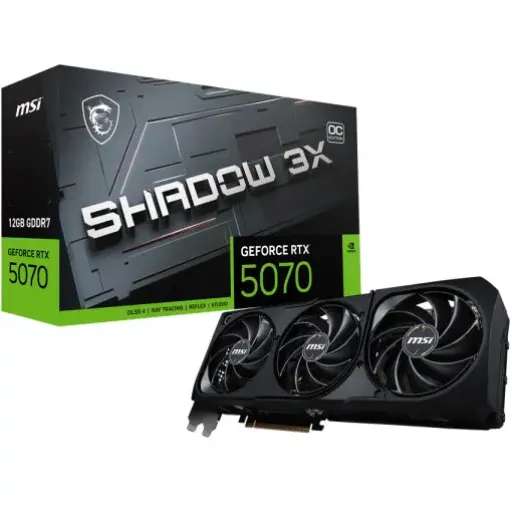
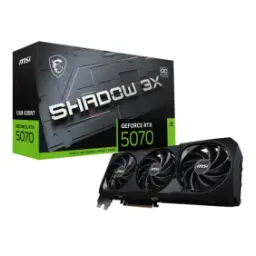
MSI GeForce RTX 5070 Shadow 3x OC


You Might Also Like
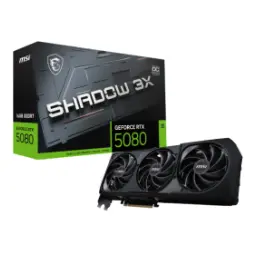
The MSI GeForce RTX 5070 SHADOW 3X OC arrives as a disciplined upper tier gaming GPU, combining NVIDIA GeForce RTX 5070 silicon with a 2542 MHz boost clock and an MSI Center Extreme Performance mode of 2557 MHz for buyers who want extra headroom without chasing an oversized flagship. The official configuration also brings 6144 CUDA cores, 12GB of GDDR7 memory, and a 192 bit memory bus, so the card starts from a very healthy foundation for modern games, heavier assets, and demanding everyday desktop use. That balance makes the SHADOW 3X OC feel practical rather than flashy, matlab raw speed ke sath build planning bhi sensible rehti hai and the card does not force you into an extreme class chassis strategy. The triple fan SHADOW cooler reinforces that identity, because sustained performance sirf spec sheet se nahi aati, balkay consistent thermals aur stable boost behavior se aati hai. If the goal is a graphics card that looks restrained, performs with authority, and keeps the overall system feeling refined, this MSI edition lands in a very convincing sweet spot
The Blackwell platform gives this card more than a generational name, because NVIDIA lists the RTX 5070 with fifth generation Tensor Cores, fourth generation Ray Tracing Cores, and the full DLSS 4 feature stack including Super Resolution, DLAA, Ray Reconstruction, Frame Generation, and Multi Frame Generation. The DLSS 4 technology page further explains that Multi Frame Generation uses AI to generate up to three frames per rendered frame on GeForce RTX 50 Series GPUs, which means the visual smoothness story yahan sirf brute force raster tak limited nahi rehti. The MSI overview page ties this directly to the product by highlighting NVIDIA Blackwell architecture, DLSS 4, and Reflex 2 support, so buyers get a card built around current gen AI assisted rendering rather than a cooler swap on older tech. The result is especially attractive for players who want richer lighting, cleaner reconstruction, and more fluid motion in supported titles, kyun ke image quality aur frame pacing dono zyada modern feel dete hain. The Reflex 2 layer also matters for competitive play, since NVIDIA lists Low Latency Mode and Frame Warp coming soon, helping the card feel responsive in the moments where quick aim and timing matter most
The memory setup is one of this card's most useful everyday strengths, because MSI specifies 12GB of GDDR7 running at 28 Gbps on a 192 bit interface, which creates a modern bandwidth foundation for current game engines and heavier texture pipelines. That combination reads especially well for buyers targeting fast 1440p monitors, large open world titles, and creator side workloads, kyun ke VRAM capacity aur memory speed mil kar scene complexity ko zyada calmly handle karte hain. The RTX 5070 family also supports PCI Express Gen 5 and Resizable BAR according to NVIDIA, so the card fits naturally into current generation gaming platforms without feeling behind the motherboard curve. For users who keep a browser open, Discord active, recording tools ready, and a game running at the same time, this spec mix feels reassuring, multitasking asaan hoti hai and the overall experience stays more composed under pressure. The 6144 CUDA core count complements that memory profile nicely, giving the SHADOW 3X OC enough compute depth to feel substantial in the upper mid enthusiast class while still staying far more measured than oversized high watt monsters
The cooler is where MSI gives the SHADOW 3X OC real day to day value, because the card uses a triple fan thermal design with TORX FAN 5.0, a nickel plated copper baseplate, square shaped Core Pipes, a reinforcing backplate, and Zero Frozr for idle silence. MSI specifically says TORX FAN 5.0 improves airflow and pressure, with ring arcs linking sets of 22 degree tilted blades and increasing airflow by 23 percent compared to axial fans, so this is not just a cosmetic three fan layout. The copper baseplate and Core Pipes matter just as much, because heat from the GPU and memory is captured quickly and spread across the heatsink, jis se long sessions mein temperature behavior zyada predictable rehta hai. Zero Frozr then keeps the card silent at lighter loads by stopping the fans when cooling demand is low, which is exactly the kind of refinement that makes a PC feel premium on an ordinary workday. MSI also lists Fuse protection and DrMOS power stages, adding small but important reliability touches that help the board stay efficient, protected, and electrically composed
The connectivity package is refreshingly current, with three DisplayPort 2.1b outputs and one HDMI 2.1b output that make the card easy to pair with esports panels, ultrawides, creator monitors, or a living room TV without awkward compromises. MSI states that the HDMI 2.1b port supports up to 4K 480Hz or 8K 120Hz with DSC, plus Gaming VRR and HDR, so the card clearly targets high refresh modern displays instead of treating output options as an afterthought. NVIDIA also lists the RTX 5070 family with support for up to four displays, HDCP 2.3, and maximum digital output in the 4K 480Hz to 8K class range with DSC, which gives the setup genuine flexibility for mixed gaming and productivity desks. That means one card can comfortably drive a fast primary gaming monitor, a side utility panel, and even a capture or media screen, yani cable planning simple rehti hai and workspace expansion feels natural. The official MSI spec sheet further confirms a digital maximum resolution of 7680 x 4320 and G SYNC technology support, so motion smoothness and display compatibility stay firmly in modern enthusiast territory
The physical design is one of this card's quiet advantages, because MSI lists the SHADOW 3X OC at 303 x 121 x 49 mm and 982 g, which is substantial enough for real cooling but still controlled enough for many thoughtful mid tower and compact enthusiast cases. NVIDIA's SFF Ready guideline sets a maximum of 304 mm length and 50 mm depth, and the GeForce RTX 5070 SHADOW 3X OC is explicitly listed within that standard at 121 x 303 x 49 mm, so the card earns a very practical fit friendly badge for cleaner compact builds. That matters in the real world because smaller or desk focused systems need predictable clearance, cable bend room, and fewer nasty surprises, bilkul especially when you are matching GPU size with side panels and front radiators. The power side stays manageable too, with MSI specifying 250 W consumption, a single 16 pin connector, ATX 3.1 PSU recommendation, and a 650 W recommended power supply, which keeps the build process modern but not extreme. Instead of demanding a giant chassis and a massive power budget, this card gives you a more measured path to high end features
The software ecosystem adds genuine value here, because MSI Center lets you monitor, tweak, and optimize the card in real time, while the product page also highlights AI Tuning for users who want a smarter, less manual approach to system adjustment. MSI also ties the card's Extreme Performance clock profile to MSI Center, where the frequency can reach 2557 MHz instead of the standard 2542 MHz boost figure, giving buyers a neat factory supported way to squeeze a little extra from the hardware. That is useful for people who want a straightforward performance preset, lekin enthusiasts ke liye bhi space banti hai because MSI Afterburner remains available for deeper clock, fan, voltage, and monitoring control. The beauty of this pairing is flexibility: a casual builder can stay inside MSI Center, while a hands on user can fine tune acoustics, thermals, and boost behavior with much more precision. The result feels refined rather than intimidating, and that makes the SHADOW 3X OC easier to live with long after the first benchmark run is over
The RTX 5070 platform is not limited to gaming alone, because NVIDIA lists one ninth generation NVENC encoder, one sixth generation NVDEC decoder, AV1 encode and decode support, NVIDIA Broadcast compatibility, and NVIDIA Studio Driver support across the RTX 5070 family. That combination is especially attractive for streamers, editors, and hybrid gamer creators, kyun ke cleaner AV1 workflows, smoother recording options, and better app level acceleration all add up to a more versatile machine. The MSI overview also frames the GeForce RTX 50 Series as a platform for gamers and creators, which fits this card well because the 12GB GDDR7 buffer and Blackwell feature set give it enough breathing room for layered timelines, GPU assisted effects, and background multitasking. For buyers who want one graphics card to handle late night ranked matches and daytime export queues, this model makes a lot of sense, render queue smooth chalti hai and the system stays feeling current for modern media tasks. NVIDIA also lists Omniverse, Broadcast, and Studio ecosystem support on the family page, which helps the card feel like a broader workstation friendly upgrade rather than a one dimensional gaming purchase
The strongest argument for the MSI GeForce RTX 5070 SHADOW 3X OC is balance, because it combines Blackwell architecture, DLSS 4 support, 6144 CUDA cores, 12GB GDDR7 memory, PCIe Gen 5 connectivity, and a triple fan cooler without drifting into an unnecessarily bulky or power hungry identity. The card also keeps modern practical details in place, including DirectX 12 Ultimate, OpenGL 4.6, G SYNC support, up to four displays, and a compact enough SFF Ready footprint that makes future case planning easier. That means the buying decision feels grounded in real everyday gains, jahan smooth high refresh gaming, cleaner thermals, current display support, and creator ready media features all move together instead of fighting each other. For anyone building a polished 1440p first PC with selective 4K ambition, low noise expectations, and an eye on current AI rendering features, this MSI edition looks particularly well judged. The SHADOW 3X OC does not try to win through excess alone; it wins by giving you the right modern technologies, a sensible thermal design, and a user experience that stays satisfying well beyond the first install
Here's how current offers compare across retailers.
Review current prices and specifications side by side.