



Price Breakdown & Availability
Here's how current offers compare across retailers.
You Might Also Like
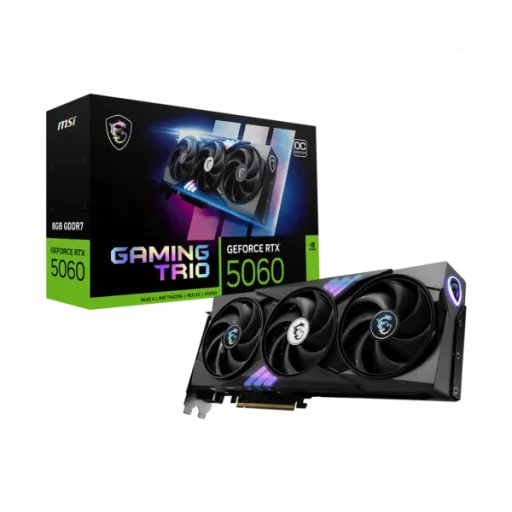
The MSI GeForce RTX 5060 Gaming Trio OC targets gamers who want a premium feel card without jumping into oversized, power hungry territory, and the vibe stays practical for daily play. The factory tuned clocks push higher boost behavior right out of the box, so most titles feel responsive with less manual tweaking, bilkul seedha install karo aur setup jaldi ho jata hai. The 3840 CUDA core layout sits in a sweet middle for modern engines, meaning 1080p high refresh and tuned 1440p become realistic goals without constant compromise. The triple fan GAMING TRIO frame focuses on sustained performance rather than quick benchmark spikes, is liye long sessions mein frame pacing zyada stable rehta hai. The overclock ready control layer stays approachable through MSI Center, so profiles and monitoring feel straightforward for new builders and returning upgraders alike. The overall footprint remains a full size, showpiece style card, giving the build a clean enthusiast look while still fitting mainstream cases with sensible planning. The result feels like a confident “set it and play” GPU where noise, thermals, and performance are balanced for rozana gaming
Modern games look their best when lighting stays realistic, and the RTX 50 series feature stack is built to keep ray traced scenes playable without constant settings anxiety. The Blackwell based RTX 5060 platform supports DLSS 4 features like Multi Frame Generation, jahan AI extra frames generate karke motion ko zyada fluid banata hai in supported titles. The official DLSS Multi Frame Generation description highlights generating up to three frames per rendered frame on RTX 50 series, which helps heavy moments feel less “choppy” when explosions, crowds, and fast camera turns stack up. The RTX 5060 family spec table also positions this tier with 5th gen Tensor Cores and 4th gen RT Cores, so AI assisted rendering and ray tracing aren’t just add ons but part of the core experience. This matters in real play because smoother delivery makes aiming, driving, and parry timing feel consistent, lag nahi hota aur input rhythm natural rehta hai. The transformer based DLSS models are also described by NVIDIA as improving stability and detail in motion, which helps reduce the “shimmer” you sometimes notice in foliage or thin wires. When you combine those tools with reasonable settings, the card becomes a strong match for gamers who want cinematic lighting but still want competitive feeling responsiveness
Everyday gaming feels better when boosting stays steady, and this Gaming Trio OC edition is tuned with an MSI listed boost of 2625 MHz plus an “Extreme Performance” mode up to 2640 MHz through MSI Center. That clock behavior pairs with 3840 CUDA cores, so shader heavy scenes don’t instantly collapse into stutter when a map gets busy, bilkul especially in open world moments. The NVIDIA reference table lists RTX 5060 boost clocks in the 2.50 GHz range, which helps explain why this tier can feel “snappy” even when you keep visuals high. The practical win shows up as smoother camera pans and cleaner motion in fast fights, is liye you spend less time fighting settings and more time playing. The card’s positioning as a performance segment GPU is also reflected in third party spec databases, which commonly frame RTX 5060 as suitable for 1080p and step up 1440p use cases. This is not about chasing bragging rights in synthetic charts, but about keeping minimum FPS and frame pacing disciplined during long sessions. When the core clock, cooling strategy, and DLSS tools align, the experience feels refined, performance bohat stable rehti hai, and the PC stays enjoyable to use
Memory behavior is where many midrange cards feel limited, and the RTX 5060 GAMING TRIO OC comes with 8GB of GDDR7 on a 128 bit bus for modern engines that stream textures on the fly. The MSI store listing also references a 28 Gbps memory speed for this RTX 5060 Gaming Trio OC lineup, which helps feed the GPU more efficiently during fast traversal and high motion scenes. Third party databases commonly map RTX 5060 to 28 Gbps effective memory and around 448 GB/s bandwidth with a 128 bit interface, giving a clearer picture of why asset heavy games can feel smoother. That bandwidth headroom can translate into fewer “texture pop in” moments, aur jab aap high detail packs use karte ho to consistency zyada achi rehti hai. The key is using smart settings and upscaling where it makes sense, because DLSS Super Resolution is explicitly designed to improve performance while maintaining strong image quality. This balanced memory approach suits competitive shooters, story games, and mixed workloads, since you can keep visuals clean without pushing the card into unstable frametimes. When VRAM is managed well, the system stays responsive in daily multitasking too, asaani se alt tab aur background apps handle ho jate hain
Cooling quality decides whether performance stays consistent, and MSI positions the GAMING TRIO OC around a TRI FROZR 4 thermal design aimed at quieter operation under load. The same product page highlights the STORMFORCE fan design and describes a seven blade layout with claw texture and a circular arc, jo airflow pressure ko improve karke heat ko jaldi move karta hai. The Zero Frozr behavior is also described by MSI as stopping fans at low temperatures, which keeps idle noise near silent for browsing, study, ya late night work. The MSI store overview further details a nickel plated copper baseplate plus square contact core pipes, along with Wave Curved 4.0 and Air Antegrade Fin 2.0 features that focus on reducing turbulence and improving airflow efficiency. That engineering matters because lower GPU temperatures typically mean fewer sudden clock drops, so gameplay feels smoother and less “spiky” across long matches. The benefit you actually notice is a calmer PC sound profile, heat kam rehti hai, and the GPU feels more comfortable sustaining its tuned boost behavior. This is the kind of cooling approach that fits builders who value stability over raw peak numbers, especially when the goal is steady FPS for hours
A graphics card upgrade feels complete when your monitor link is future facing, and this model provides three DisplayPort 2.1b outputs plus one HDMI 2.1b output for flexible setups. The HDMI spec line on MSI’s page explicitly mentions support up to 4K 480Hz or 8K 120Hz with DSC, along with Gaming VRR and HDR, jo high end TVs aur next gen monitors ke saath compatibility ko strong banata hai. The card is rated for up to four displays, so dual monitor productivity plus a gaming panel is easy to manage without extra adapters. The listed digital maximum resolution reaches 7680 x 4320, which is useful for high resolution output scenarios even if most gaming is done at more practical resolutions. G SYNC support is also called out on MSI’s spec page, which helps keep motion smoother by reducing tearing when frame rates fluctuate. This kind of I/O layout is ideal when you want a clean cable plan and dependable handshake behavior, asaani se plug karo aur scene set. When display links stay modern, the GPU’s rendering features translate more directly into what your eyes actually see on screen
Platform compatibility becomes easier when the basics are clear, and MSI specifies a PCI Express Gen 5 x16 interface that operates electrically as x8 on this card. That design means it installs into a standard x16 slot on most motherboards, while lane usage stays efficient for the GPU class, bilkul practical for mainstream builds. The power draw is listed at 155W with a single 8 pin connector, keeping the upgrade path simpler than cards that demand new cabling standards. MSI also recommends a 550W PSU, which is a helpful planning anchor when you’re pairing a modern CPU and multiple drives. Third party spec references similarly describe RTX 5060 as a PCIe 5.0 x8 card with an 8 pin power connector, reinforcing the overall “easy integration” profile. The physical card dimensions are listed as 300 x 125 x 44 mm, so case clearance and front radiator spacing should be checked once, phir tension khatam. When power and fit remain predictable, you can focus on tuning your games instead of troubleshooting random shutdowns or airflow issues
A GPU feels more premium when software control is polished, and MSI highlights MSI Center for monitoring, tweaking, and optimizing behavior in real time alongside the widely used Afterburner toolset. That kind of tuning is especially useful when you want a quiet desktop during work and a stronger profile at night, kyun ke profiles switch karna asaan ho jata hai. On the NVIDIA side, the DLSS page explains how DLSS Super Resolution, Ray Reconstruction, and Multi Frame Generation are designed to boost performance while maintaining image quality, giving you real levers for demanding games. NVIDIA’s own GeForce News post also describes DLSS override features inside the NVIDIA app, including the ability to apply DLSS override settings globally instead of per game, which reduces setup friction for big libraries. The same NVIDIA post details options like enabling Multi Frame Generation overrides (where compatible) and upgrading DLSS models, so older titles can sometimes benefit from newer AI pipelines, bilkul without waiting for game patches. This software layer matters for creators too, because NVIDIA and MSI both frame RTX 50 series cards as accelerators for creative apps and AI assisted workflows, making the GPU useful beyond gaming. When control tools stay unified, the overall experience feels refined and predictable, performance stable rehti hai, and troubleshooting becomes faster
A smart GPU purchase starts with honest fit, and the RTX 5060 class is commonly framed as a strong choice for 1080p performance and a practical step into 1440p when settings are chosen well. The core spec foundation of 3840 CUDA cores with 8GB GDDR7 on a 128 bit bus gives the card enough throughput for modern engines, while still feeling manageable in heat and power, rozana use mein bhi. The Gaming Trio OC clocks are clearly specified by MSI, so you’re not guessing what “OC” means in practice when you compare models. The DLSS 4 toolkit exists to stretch performance in supported games, and NVIDIA describes Multi Frame Generation as generating up to three frames per rendered frame on RTX 50 series, which can keep motion smooth when you push visual features. The TRI FROZR 4 cooling approach is built around quieter operation and upgraded airflow control, so long gaming sessions feel less stressful on the system, heat kam aur fan noise kam. The output stack of DP 2.1b and HDMI 2.1b plus 4 display support also makes it easier to grow into better monitors later without replacing the card. When you want a balanced RTX 50 series experience with modern ports, modern memory, and practical power, this MSI GeForce RTX 5060 Gaming Trio OC sits in a competitive enthusiast friendly lane
Here's how current offers compare across retailers.