

Price Breakdown & Availability
Here's how current offers compare across retailers.
You Might Also Like
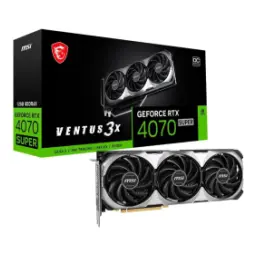
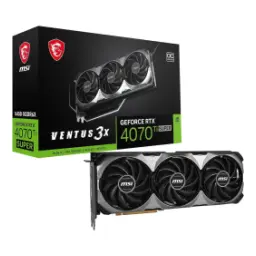
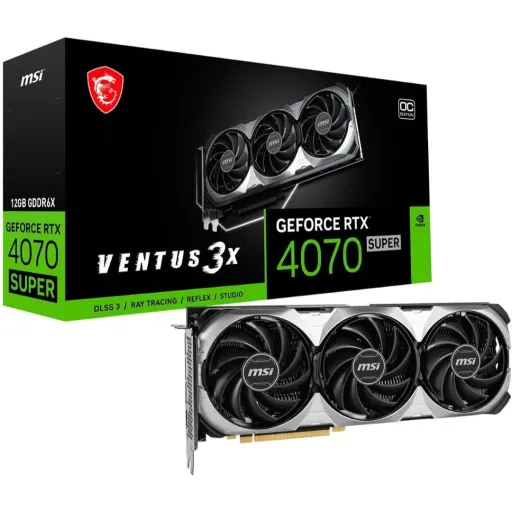
The MSI GeForce RTX 4070 Super Ventus 3X OC sits in that sweet performance tier where serious gaming, streaming, aur day to day creator work all feel naturally within reach. MSI pairs the RTX 4070 SUPER GPU with a factory boost clock of 2505 MHz, while MSI Center can raise the Extreme Performance profile to 2520 MHz, so out of box speed already feels tuned rather than bare minimum. NVIDIA also showcases RTX 4070 SUPER performance on its official family page at 2560x1440 with highest settings, which tells you this class is aimed at demanding QHD play, samajh lo yeh card modern visual load ko confidence ke sath handle karne ke liye built hai. The VENTUS identity keeps the focus on practical strength instead of decorative excess, and that matters when you want clean airflow, stable clocks, aur long sessions without distracting acoustics. MSI further labels this model as an SFF Ready Enthusiast GeForce card, so compact leaning builds also stay realistic if the case is planned properly. The result feels balanced from the first install, giving you a GPU that aims for sustained usefulness instead of chasing headline specs alone
The Ada Lovelace foundation gives this card its real personality, because 7168 CUDA cores, fourth generation Tensor hardware, aur third generation ray tracing capability are what keep modern effects from feeling like a burden. NVIDIA lists 36 shader TFLOPS, 82 RT TFLOPS, and 568 AI TOPS for the RTX 4070 SUPER family, which means the silicon is not only quick in classic rendering but also far more prepared for AI assisted workloads and heavier ray traced scenes. That matters in real play, kyun ke denser lighting, richer effects, aur upscale features stop feeling like an instant compromise. MSI's factory OC layer keeps boost behavior more assertive from day one, so frame pacing stays steadier when the scene suddenly gets busy. The PCI Express Gen 4 interface also keeps the card aligned with current platforms, making it an easy performance step for users building fresh systems or replacing older midrange hardware. This is the kind of core setup that feels fast now and still sensible later
The triple fan thermal design is one of the biggest reasons this VENTUS card feels refined during long sessions, because cooling quality decides whether performance stays confident or starts to wobble. MSI pairs three fans with a large heatsink and describes the result as a cool and quiet experience, jo rozana gaming ya editing mein bohat practical advantage ban jata hai. TORX Fan 4.0 links fan blades in paired sections to focus airflow, while Airflow Control and deflectors push air exactly where extra cooling is needed. MSI also uses a nickel plated copper baseplate and precision Core Pipes that maximize GPU contact, so heat spreads quickly instead of collecting in one hotspot. Zero Frozr stops the fans when temperatures are relatively low, which keeps idle noise down and makes the desktop feel calmer. A reinforcing backplate with flow through ventilation completes the design, aur is combination ki wajah se clocks zyada composed rehte hain when the workload lasts longer
The 12GB GDDR6X memory setup gives this card breathing room where it actually counts, especially for high resolution textures, larger game assets, aur layered creative timelines. MSI rates the memory at 21 Gbps on a 192 bit bus, which translates into fast data movement that helps heavy scenes load and respond with less hesitation. That balance is especially useful if you jump between gaming, recording, browser tabs, aur background apps, because the card does not start feeling cramped the moment visual settings climb. MSI also highlights NVIDIA Encoder, NVIDIA Broadcast, and NVIDIA Studio on the product page, while NVIDIA Studio positions RTX acceleration for faster video editing, smoother 3D rendering, and more seamless livestreaming. In daily use this means OBS setups, short form edits, and render previews feel more cooperative, yani workflow ruk ruk kar chalne ke bajaye smooth rehta hai. This memory profile will not feel wasteful for focused gaming, and it also avoids feeling too thin for mixed use desktops
Ray traced games feel far more inviting on this GPU class because the RTX 4070 SUPER combines third generation RT cores with DLSS 3 support, so visual upgrades do not automatically crush fluidity. NVIDIA explains that DLSS 3 uses fourth generation Tensor Cores and the Optical Flow Accelerator to create additional frames and improve image quality, and the company says supported workloads can see up to 4x the performance of brute force rendering. That advantage matters most when cinematic lighting, reflections, aur dense effects start stacking on screen, kyun ke smoothness phir bhi reachable rehti hai in supported titles. NVIDIA Reflex adds another practical edge by synchronizing GPU and CPU work for lower PC latency, which helps competitive games feel quicker and more immediate. The end result is not just prettier output; it is a system that feels sharper in the hands, whether you value story heavy visuals or faster reactions in online matches
The port layout makes real world setup painless, because three DisplayPort 1.4a outputs and one HDMI 2.1a output cover the monitor combinations most buyers actually use. MSI states that the HDMI port supports 4K at 120Hz HDR, 8K at 60Hz HDR, and Variable Refresh Rate as specified in HDMI 2.1a, which is excellent if one screen is a living room TV or a premium high refresh panel. The card also supports up to four displays, G SYNC technology, and a digital maximum resolution of 7680 x 4320, so a dual monitor desk, streaming side panel, aur main gaming screen can all coexist cleanly. This flexibility feels especially useful for mixed users who game at night and work by day, kyun ke cable juggling aur adapter headaches stay low. Even if you upgrade the monitor later, the output stack already feels ready for more ambitious display plans
Physical planning stays refreshingly straightforward with this model, since MSI lists dimensions of 308 x 120 x 43 mm and a card weight of 821 g. Those numbers tell you the cooler is substantial enough for steady thermals, lekin it still avoids the giant, overbearing feel that can complicate a cleaner mid tower build. The card uses one 16 pin power connector, draws 220 W, and comes with a 650 W recommended PSU target, so system matching remains serious but not extreme. MSI also classifies it as an SFF Ready Enthusiast GeForce card, which adds confidence for builders chasing smaller footprints with proper case clearance. In practical terms you get upper performance graphics muscle, magar power planning aur installation tension unnecessarily scary nahi banti. That makes the upgrade path feel mature, especially for buyers who want performance without turning the whole PC into a heat and cable management project
MSI gives this card more than raw hardware appeal, because the surrounding software makes tuning, monitoring, aur day to day control much easier for first time builders and experienced tweakers alike. MSI Center can monitor, tweak, and optimize the GPU in real time, and MSI AI Engine learns user behavior to adjust settings without demanding constant manual fiddling. User Scenario profiles in MSI Center let you shift performance and fan behavior for different use patterns, jo tab kaam aata hai jab kabhi gaming karni ho aur kabhi silent productivity mode chahiye ho. MSI Afterburner adds the deeper layer, offering real time metrics, broad overclocking control, and OC Scanner for automated stable tuning. MSI even lists an Extreme Performance profile of 2520 MHz through MSI Center, so there is a simple path for squeezing a bit more speed out of the card without turning the experience into guesswork. This software stack keeps the hardware feeling approachable, and that convenience often matters just as much as one extra line on a spec table
The overall package feels convincing because it blends 7168 CUDA cores, 12GB GDDR6X memory, triple fan cooling, aur modern AI gaming features into a card that stays focused on usable performance. DirectX 12 Ultimate support, OpenGL 4.6 support, and Game Ready plus Studio driver positioning give it the kind of compatibility that makes a system feel current instead of temporary. Buyers who want flashy excess may look higher, but users who care about balanced speed, stable thermals, and smarter feature support will find this VENTUS edition especially easy to justify. NVIDIA built the RTX 4070 SUPER family on Ada Lovelace for gaming and creating, aur MSI adds the practical cooler, clean connectivity, and tuning tools that turn that foundation into a more complete daily card. If the goal is a competitive upper performance build that feels fast today and sensible tomorrow, this model lands with very little wasted effort
Here's how current offers compare across retailers.
Review current prices and specifications side by side.