









Price Breakdown & Availability
Here's how current offers compare across retailers.
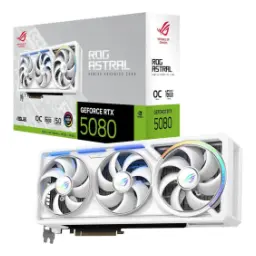
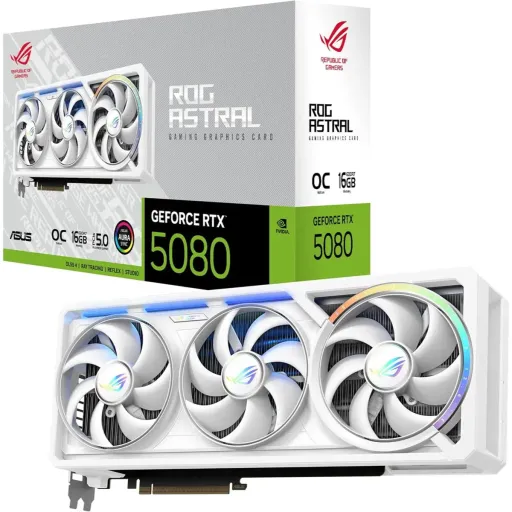
ASUS GeForce RTX 5080 ROG Astral


You Might Also Like
This ROG Astral edition elevates the RTX 5080 into a showpiece, case ke andar bhi premium vibe clear nazar aati hai, without losing the “tool for performance” mindset. The quad‑fan Astral approach is positioned as ROG’s first four‑fan graphics card, so airflow and pressure get treated like a performance feature rather than an afterthought. The core RTX 5080 foundation brings 10,752 CUDA cores on NVIDIA’s Blackwell architecture, which keeps modern engines responsive when settings climb and frametimes matter. The 16GB GDDR7 memory target is practical for high texture games and creator timelines, aur “VRAM full ho gayi” wali tension late night sessions mein kam hoti hai. The 256‑bit interface anchors that memory to consistent throughput, so large worlds and complex scenes feel steadier instead of random micro stutter. This Astral styling also leans into die‑cast metal rigidity and bracket support, matlab heavy card sag ka risk reduce hota hai while the build looks intentional
This Blackwell generation focuses on neural rendering features, jis ka matlab yeh hai ke visuals sirf bright nahi balkay smarter feel hotay hain, especially when ray tracing is switched on. The RTX 5080 platform includes 4th‑gen ray tracing cores and DLSS 4 capabilities, so reflections, shadows, aur global lighting ka depth zyada natural lagta hai in supported titles. The RTX 50‑series announcement highlights new RT cores built for “Mega Geometry” workloads, which helps modern scenes carry more detailed geometry without immediately collapsing performance. The ROG Astral product positioning directly calls out DLSS 4 with Multi Frame Generation, giving you a clear pathway to higher perceived smoothness when native rendering would be heavy, bilkul useful for 4K ambitions. The same RTX 50‑series notes also mention DisplayPort 2.1b support, which matters if a high refresh, high resolution monitor is part of the plan because bandwidth headroom stays modern. This combination translates into a more stable “cinematic + responsive” experience, tooti hui pacing ka masla kam hota hai, and the upgrade feels visible even outside benchmark charts
This GPU’s raw engine is designed for throughput, so high refresh gameplay can stay controlled when explosions, particles, aur heavy shaders simultaneously hit the screen. NVIDIA lists the GeForce RTX 5080 at 10,752 CUDA cores with a 2.62GHz boost clock and 2.30GHz base clock, which is the kind of headroom that helps maintain responsiveness during sudden load spikes. The manufacturing node is widely cited as a 5nm class build for the RTX 5080 (GB203), and that efficiency profile usually shows up as better performance per watt behavior, heat kam aur boosts zyada stable. The Blackwell platform also brings 5th‑gen Tensor cores and 4th‑gen RT cores as part of the standard RTX 5080 feature set, so AI assisted rendering and ray workloads aren’t “bonus modes” but part of how performance is delivered. The Astral treatment pairs that silicon with an aggressive cooling concept, meaning clocks can hold longer in real sessions, rozana ke use mein bhi “throttle” wali feel kam hoti hai. This is the kind of GPU that aims to make demanding settings feel routine, and it rewards builders who care about consistency more than one time peak numbers
This memory configuration is built for modern assets, so high resolution textures and large open worlds don’t immediately force compromises. NVIDIA specifies 16GB of GDDR7 on a 256‑bit memory interface for the RTX 5080, giving you practical capacity for games, mods, and creator caches, storage kafi aur workflow asaan. The RTX 50‑series launch notes emphasize that Blackwell is paired with GDDR7 and mentions speeds up to 30Gbps, which is exactly the kind of bandwidth story that keeps 4K pipelines and heavy scenes from feeling “stuck”. TechPowerUp’s database lists RTX 5080 memory at 30Gbps effective with a 256‑bit bus and up to 960GB/s bandwidth, so texture streaming and frame delivery can stay smoother under pressure. The practical benefit is simple: game loads feel less hitchy when you spin the camera fast, aur creators ko timeline scrubbing mein zyada confident rhythm milta hai. This also helps multi monitor usage where multiple high res surfaces compete for memory bandwidth, and the experience stays refined instead of fragile. The result is not just “more VRAM,” but better headroom where it matters most: consistent motion and fewer bottlenecks in real play
This Astral cooler is engineered to protect performance over time, because sustained clocks matter more than a quick burst benchmark. ASUS positions ROG Astral as a quad‑fan design that boosts airflow and pressure by up to 20%, so heat removal is treated like a core capability, bilkul long gaming nights ke liye. The same product page highlights a patented vapor chamber with a milled heatspreader, and it pairs that with a phase‑change GPU thermal pad to improve heat transfer and reliability under load. ASUS also describes the four‑fan layout as creating a vertical airflow channel that boosts pressure by up to 20% and “dramatically lowers GPU temperatures,” which helps reduce hotspot driven clock drops in tough scenes. The cooling design is tied to a 3.8‑slot heatsink and fin array, meaning the card is physically serious about dissipation, thori si space sacrifice karke stability gain hoti hai. The net effect is a more confident, repeatable performance feel, and that “heat kam, boost zyada” comfort becomes part of everyday ownership
This RTX 5080 platform is tuned for mixed workloads, so gaming and creation can live on the same machine without constant compromises. NVIDIA lists 5th‑gen Tensor cores and an AI performance figure of 1801 AI TOPS for RTX 5080, which supports the broader DLSS 4 and AI assisted rendering pipeline in compatible software. The ROG Astral page also calls out AI Performance at 1801 AI TOPS and frames the card as “the ultimate platform for gamers and creators,” which matches real world needs like smoother edits and faster iteration, rozana ka creative kaam tez hota hai. ASUS explicitly mentions NVIDIA Studio creator tools, NVIDIA Broadcast, and a ninth‑gen NVIDIA Encoder in the product messaging, making this card relevant for streaming overlays, noise cleanup, and encode heavy workflows. NVIDIA also lists Reflex 2 support on RTX 5080, which is a tangible benefit for competitive titles where input feel and timing matter, lag nahi aur response tight. This is the kind of GPU that makes “play + publish” feel natural, and it keeps your PC ready for both ranked sessions and production deadlines
This card’s long session confidence comes from construction, because a premium GPU should feel stable in both performance and physical mounting. ASUS highlights powerful 50‑amp MOSFETs with extra power phases for over 25% more headroom compared to reference design, which supports higher overclocking potential and sustained stability, performance bohat stable rehti hai. ASUS also details GPU Guard adhesive securing all four corners plus a GPU bracket for uniform mounting pressure, so transport and heavy cooler weight are handled more safely. The protective conformal PCB coating is described as guarding against moisture, dust, or debris related short circuits, which is practical in real homes where cleaning schedules aren’t perfect, ghar ka environment kabhi kabhi dusty hota hai. The Auto‑Extreme manufacturing process is presented as a single pass soldering approach that reduces thermal strain on components, aiming for consistency rather than luck of the draw outcomes. ASUS also emphasizes a full metal diecast shroud, frame backplate, and rear I/O bracket for rigidity, which keeps the build feeling premium and dependable over time
This GPU deserves a clean system plan, because the best experience comes when airflow, PSU, and cabling are handled thoughtfully. TechPowerUp lists the RTX 5080 as a PCIe 5.0 x16 card with a 360W rated power draw, using a single 16‑pin power connector and a suggested 750W PSU, so power budgeting should be intentional, asaani se stable build ban jata hai. TechPowerUp also notes RTX 5080 display outputs as HDMI 2.1b plus DisplayPort 2.1b, which is a strong match for high refresh displays and modern multi monitor desks. The ROG Astral design uses a 3.8‑slot cooler and emphasizes a massive heatsink and fin array, so case clearance and neighboring slot planning should be confirmed before purchase, thori si measurement pehle kar lena best hai. ASUS also mentions Power Detector+ for monitoring anomalies across 12VHPWR cable pins, which supports safer ownership habits by prompting reseating if needed. This kind of planning keeps the upgrade smooth, and it protects you from the classic “great GPU, messy build” disappointment
This RTX 5080 class targets ambitious builds, so the goal is premium smoothness with features that remain relevant as games become more AI driven. TechPowerUp characterizes the GeForce RTX 5080 as an enthusiast class GPU in the GeForce 50 generation, which is exactly the segment where 1440p high refresh and selective 4K aspirations start feeling realistic, future ke liye headroom milta hai. NVIDIA’s official RTX 5080 spec page reinforces the key pillars: Blackwell architecture, 10,752 CUDA cores, 16GB GDDR7, a 256‑bit interface, and DLSS 4 feature support, which together translate into smoother motion and higher visual fidelity in supported titles. The ROG Astral version adds a very deliberate thermal and mechanical story with its quad‑fan cooling concept, vapor chamber, and rigid frame, so performance feels less fragile under long sessions, heat kam aur confidence zyada. This is a strong pick for players who want ray traced visuals without constant tweaking, and for creators who want faster iteration without moving to workstation hardware. The upgrade makes the most sense when the rest of the system is balanced, and the payoff is a setup that feels premium every single day
Here's how current offers compare across retailers.
Review current prices and specifications side by side.