


Price Breakdown & Availability
Here's how current offers compare across retailers.
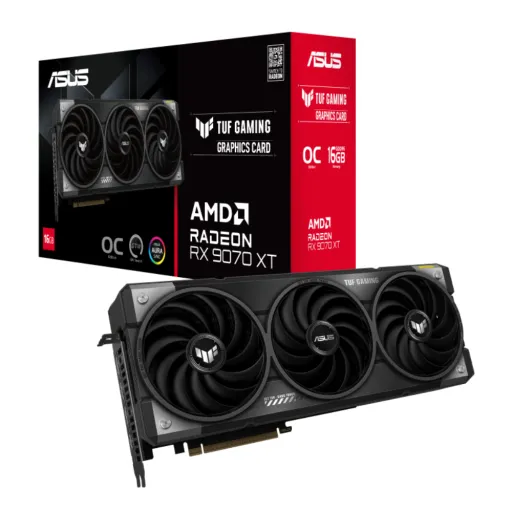
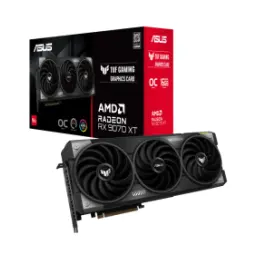
ASUS Radeon RX 9070 XT TUF Gaming

You Might Also Like
The ASUS Radeon RX 9070 XT TUF Gaming is built for gamers who prioritize durability, stable clocks, and predictable day to day behavior. This TUF edition focuses on sustained play, rozana ke marathons mein, so the experience stays smooth without constant tweaking. The Radeon RX 9070 XT platform is based on AMD RDNA 4 architecture, which is designed to bring newer ray tracing and AI forward features into mainstream gaming. The 16GB GDDR6 memory pool helps modern games breathe, textures load asaani se, and heavy open worlds feel less “memory tight” at higher settings. ASUS highlights long term reliability choices like a metal exoskeleton, protective PCB coating, and military grade components for power delivery consistency. The phase change GPU thermal pad concept is meant to reduce thermal wear points, heat transfer better hota hai, and performance stays steady under extended load. A Dual BIOS switch supports quiet or performance modes, which is a practical win when silence matters or when headphones are off. This overall positioning makes sense for builders who want fewer surprises, lag nahi chahiye, and a card that feels engineered for years of use
The ASUS TUF RX 9070 XT OC model provides modern display connectivity for high refresh gaming and high resolution creator workflows. This card includes one HDMI 2.1b port and three DisplayPort 2.1a ports, jo multi monitor setup ko simple banata hai, while keeping bandwidth ready for newer panels. The maximum digital resolution is listed as 7680 x 4320, which supports big screen ambitions like 8K output for media, testing, or professional preview needs. ASUS also calls out DisplayPort 2.1 outputs as a key advantage for high refresh rate and high resolution combinations. The four display support keeps productivity clean, rozana ka workflow smooth rehta hai, especially when you split game, chat, capture, and monitoring across screens. The practical benefit shows up in motion clarity, because high refresh monitors can finally be fed consistently when settings are balanced correctly. The port selection also reduces adapter dependence, asaani se connect hota hai, so cable management stays simple and less error prone. A modern I/O stack matters for longevity, because monitors outlast GPUs in many builds and bandwidth headroom protects your next upgrade cycle. This is where the TUF approach feels grounded, keeping connectivity current instead of chasing gimmicks
The ASUS Radeon RX 9070 XT TUF Gaming runs on a PCI Express 5.0 interface, which keeps platform bandwidth modern for current motherboards and future refreshes. This GPU configuration lists 4096 stream processors, jo raster workloads mein strong parallel throughput deliver karte hain, especially at 1440p where consistency matters most. The RDNA 4 foundation is paired with ASUS factory tuning, so you get defined Game Clock and Boost Clock behavior rather than random spikes. The listed OC mode boost reaches up to 3080 MHz, performance bohat stable feel hoti hai, when cooling is doing its job and the case airflow is sensible. The default boost is specified up to 3060 MHz, which helps keep real world behavior predictable across different games and drivers. TechPowerUp’s board entry also aligns this variant with PCIe 5.0 x16 connectivity, which is useful for buyers confirming platform fit. The real benefit is responsive input, lag nahi hota, because frame pacing tends to improve when clocks and thermals are steady. This setup suits gamers who want strong baseline performance today without gambling on fragile overclocks tomorrow
The ASUS TUF RX 9070 XT OC is designed with a robust power setup, helping it hold clocks reliably during heavy scenes and long matches. This model specifies three 8 pin power connectors, jo power spikes ko handle karne mein madad karte hain, when modern games shift rapidly between light and intense frames. ASUS lists a recommended 850W PSU for this card, which is a straightforward planning number for builders who prefer safe overhead instead of borderline stability. AMD’s reference guidance for the RX 9070 XT family includes a 304W TBP, so it helps to pair the GPU with solid airflow and a quality power supply in the same performance class. This kind of electrical headroom matters in real gameplay, kyun ke sudden drops or instability usually feel worse than slightly lower peak FPS. The TUF focus on military grade components targets consistent power delivery, asaani se stable rehta hai, especially when ambient temperatures rise. The practical outcome is fewer “mystery resets” and less troubleshooting, because the system is not constantly running at the edge. This section is not about chasing extreme numbers, because long term smoothness is often the real upgrade you notice daily
The RDNA 4 generation introduces 3rd generation ray tracing accelerators, improving ray tracing throughput per compute unit compared to the prior generation. This matters when reflections and shadows get heavy, kyun ke ray tracing ka pressure usually frametime ko rough kar deta hai, even on powerful cards. AMD also positions FidelityFX Super Resolution 4 as an ML powered upscaling option for demanding workloads like 4K gaming with maximum ray tracing settings in supported titles. The core benefit is sharper perceived detail at higher frame rates, asaani se playable feel aati hai, because upscaling reduces native render cost. AMD describes HYPR RX as a one click way to enable a suite of latency and performance features inside AMD Software, including Anti Lag and Fluid Motion Frames 2.1. This ecosystem approach helps when you want quick tuning, rozana game switch karte hue, without spending time hunting settings for every title. The FSR technologies page also frames ML based FSR options as exclusive to Radeon RX 9000 series hardware, which clarifies the intended pairing with RDNA 4 GPUs. The result is a cleaner way to chase higher refresh targets, because you trade some native rendering for smarter reconstruction rather than simply lowering every visual setting
The TUF Gaming RX 9070 XT design emphasizes temperature control, because sustained boost behavior depends on stable thermals more than short benchmark bursts. ASUS describes a trio of 11 blade Axial tech fans paired with 0dB fan technology, so light workloads stay silent and gaming loads push focused airflow through the fin array. This kind of fan behavior helps daily use, kyun ke browsing and videos mein unnecessary noise bilkul nahi chahiye, while gaming still gets the cooling it needs. ASUS also mentions wide vents on an aluminum backplate to support heat exhaust, which complements cases with strong front to back airflow patterns. The phase change GPU thermal pad is presented as a longevity focused upgrade over traditional paste, heat transfer better hota hai, because it fills microscopic gaps as it warms and spreads. Dual ball fan bearings are also cited for extended fan lifespan compared to conventional designs, which is a practical reliability win for long ownership cycles. A physical Dual BIOS switch supports quiet or performance preference, asaani se toggle hota hai, without requiring extra software. This cooling and control package is meant to keep heat kam and clocks consistent, because smooth pacing is what you actually feel in the middle of a match
The ASUS TUF RX 9070 XT comes with 16GB of GDDR6 memory, giving games more room for high resolution texture packs and heavy open world asset streaming. This memory rides on a 256 bit interface, jo bandwidth ko balanced rakhta hai, so performance does not collapse when scenes become visually dense. ASUS lists a 20 Gbps memory speed, which helps keep higher settings practical when you are targeting sharper image quality instead of constantly trimming textures. PC Gamer’s published table also reflects 16GB GDDR6 at 20 Gbps on a 256 bit bus for the RX 9070 XT class, reinforcing the platform level intent for 1440p and 4K gaming scenarios. This headroom supports multitasking habits, rozana streaming ya Discord saath, because the GPU can juggle game assets while driving multiple displays. The practical payoff is fewer abrupt stutters, because VRAM pressure is a common hidden bottleneck once you push higher fidelity. This memory setup feels especially relevant today, because modern engines love caching and preloading more data than older GPUs were built to handle
The Radeon RX 9070 XT is framed by AMD as a major step up for 1440p gaming, with company testing citing over 40% more performance on average versus the RX 7900 GRE at 1440p. This claim matters for real buyers, kyun ke 1440p high refresh is where frame consistency becomes the difference between “fast” and “feels fast.” TechPowerUp’s GPU database positions the RX 9070 XT class as suitable across 1080p, 1440p, and 4K gaming resolutions, which aligns with the idea of a flexible high end card rather than a single resolution specialist. A review perspective also highlights the RX 9070 XT as particularly strong in rasterization at 1440p, and surprisingly capable at 4K when FSR 4 is used in supported games. This balance supports practical settings choices, rozana ke use mein, because you can keep visuals high while leaning on upscaling when needed. AMD also emphasizes FSR 4 as ML powered upscaling for demanding workloads, which connects directly to the “4K without panic” experience many gamers want. The value here is not about chasing extremes, because stable frame pacing and modern features usually outlast raw peak FPS bragging rights. This is why the TUF variant makes sense, as it aims to keep performance steady and heat kam across long ownership cycles
The ASUS TUF RX 9070 XT OC is a physically substantial card, with listed dimensions of 330 x 140 x 62.5 mm for clear case fit planning before you buy. This size and cooling intent means airflow matters, asaani se best results milte hain, when your chassis has strong intake and clean exhaust routing. ASUS includes a TUF graphics card holder in the box, which helps reduce sag risk and keeps the build looking aligned over time. ASUS also lists a Dual BIOS switch for quiet or performance modes, which simplifies “one build, two moods” usage depending on whether you are gaming late night or running fans aggressively. The port layout provides one HDMI 2.1b and three DisplayPort 2.1a outputs, so monitor upgrades remain straightforward without adapter drama. ASUS recommends an 850W PSU and uses three 8 pin connectors, jo power planning ko clear banata hai, especially for builders who prefer conservative overhead. ASUS points users toward GPU Tweak III for tuning and monitoring, which helps keep fan curves and thermals under control without third party tools. This final picture suits buyers who want a modern RDNA 4 GPU with TUF practicality, because the details are stated clearly and the build decisions stay predictable
Here's how current offers compare across retailers.
Review current prices and specifications side by side.